
In today’s world, children are born into technology. Especially the generation called Generation Alpha starts interacting with digital tools at a very early age. Research shows that the age at which children meet technology is getting lower, and the digital world plays an important role in their development. However, this rapid digitalization brings an important question:
Will children grow up only as consumers of technology, or will they become creators who use it consciously and meaningfully?
This is where sustainability and design come into play.
Children Growing Up in a Digital World and the Need for “Balance”
One of the most important topics in parenting today is a “balanced digital life.” Instead of completely banning technology, it is now widely accepted that it should be guided in the right way. The most important factor in children’s development is not only what they are exposed to, but how they interact with it. This early interaction directly shapes how they think, solve problems, and understand the world.
For this reason, technology should not remain a passive consumption tool for children, but should become an active space for creation and exploration.
Sustainability and Design: An Alternative Path in the Digital World
Workshops based on sustainable design are one of the most effective tools to support this transformation. In these workshops, children:
- Learn to produce instead of consume
- Discover that objects can have more than one purpose
- Understand that resources are limited
- Improve creative and critical thinking skills
Design becomes not only an aesthetic activity, but also a way of thinking. When children look at an object, they no longer only ask:
“What is this?”
They begin to ask:
“What else could this be?” and “How can I make this more functional?”
SETAP’s New Workshop
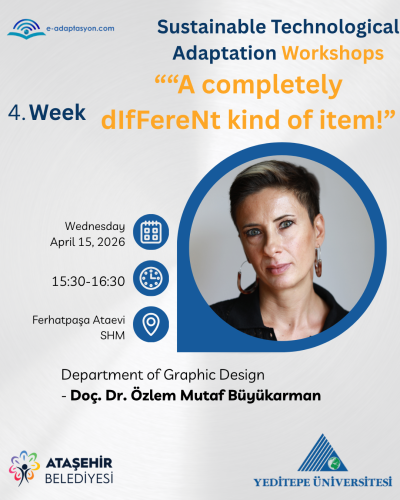
As part of the SETAP (Sustainable Technological Adaptation Project), a workshop titled “bAmbAşka bir eşya!” was held on April 15, 2026. It was guided by Assoc. Prof. Dr. Özlem Mutaf Büyükarman from Yeditepe University’s Department of Graphic Design, with the participation of E-Commerce students.
In this workshop, children experienced a holistic learning model combining sustainability, design, and technology. Based on given concepts, each child reinterpreted and redesigned an object through drawing.
For example, using the concept of “reducing,” children worked on the object of a clock and were asked to remove certain parts and redesign it. Through these changes, they created completely new visual designs and experienced that objects do not have a single fixed form.
This process helped them develop creative thinking and visual design skills while discovering different ways to rethink objects.
Technological Adaptation: From Consumption to Production
Raising children in the digital age is not only about limiting technology, but about integrating it meaningfully. Sustainable technological adaptation aims exactly this.
It teaches children to see technology as:
- Not just a tool for entertainment
- A tool for problem-solving
- A support for design
- A platform for developing functionality
For example, a child can see a transformed material not just as a toy, but as a product that solves a problem. This is the foundation of technological thinking.
From “Lonely Digital Child” to “Creative Individual”
Studies on Generation Alpha show that children spend more time in digital environments, and their social interactions are changing. This can increase the risk of isolation. However, well-designed learning environments can turn this risk into an advantage.
Sustainability and design-based workshops:
- Connect children with physical creation
- Increase social interaction
- Use technology as a tool
- Provide meaningful learning experiences
In this way, children move beyond being passive consumers and become individuals who create, think, and transform.
Conclusion
Raising children in the digital age is no longer just about controlling screen time. The real challenge is shaping how children relate to technology.
Sustainability and design-focused approaches are powerful tools to guide this relationship. They teach children not only how to use technology, but how to understand, create, and transform with it.
And most importantly, they give children this perspective:
Technology is not something to consume, but a tool that, when used correctly, can make the world a better place.
The future will be shaped by children who think this way.