Is a piece of wool really just “waste”?
Or can unused materials, with a little imagination, be transformed into entirely new designs?
During the sixth-week workshop organized within the scope of SETAP (Sustainable Technological Adaptation Project), children explored the answers to these very questions together. The “Sustainable Design” workshop, organized through the collaboration of Ataşehir Municipality and Yeditepe University’s Department of E-Commerce, became a creative learning space where children both experienced production processes and became closely acquainted with the concept of sustainability. It also represented the first spark of future designers in the making.
What Is Sustainable Design?
Sustainable design is an approach that aims to use natural resources responsibly, reduce waste, and produce without harming the environment. Today, due to rapid consumption habits, many products quickly become waste, whereas sustainable design encourages the reuse of existing materials and promotes long-lasting production. Especially in the textile industry, leftover fabrics, yarns, and production materials can be transformed into reusable products through creative ideas. In this way, both the environment is protected and consumption habits become more conscious.
This approach is not limited to recycling alone. It also encourages individuals to question production processes, consume only what they need, and recognize the value of resources. Awareness gained at an early age contributes to raising more environmentally conscious individuals in the future.
Why Should Sustainability Be Learned in Childhood?
Instilling sustainability awareness during childhood is of great importance for raising environmentally conscious individuals in the future. Childhood is one of the most critical developmental stages during which habits, values, and ways of thinking are formed. Behaviors learned at this age can evolve into lifelong awareness rather than short-term habits. Practices such as saving water, understanding the importance of recycling, consuming only what is necessary, or reusing unused materials become a natural part of children’s daily lives when learned early.
Today’s culture of rapid consumption directly affects children as well. From toys and clothing to digital devices and everyday products, many items quickly lose their value and are discarded. For this reason, it is highly important for children to become familiar with the concepts of “reusing” and “transforming” instead of simply “consuming” from an early age. Sustainability education not only teaches children to protect the environment, but also helps them understand that resources are not unlimited and that every product has a production process and environmental impact.
Sustainability education delivered through hands-on workshops makes the learning process more permanent and meaningful for children. When children create a new product by reusing a material, they learn the concept of recycling not only theoretically but also through direct experience. This process supports their creativity while also developing problem-solving, productive thinking, and responsibility skills.
Sustainability awareness gained in childhood also creates an important social impact. Environmentally conscious individuals not only change their own habits but can also influence the people around them. In this way, a culture of sustainable living can be passed down from generation to generation. Considering that today’s children will become the consumers, producers, and decision-makers of the future, sustainability education can be seen as a long-term investment in a more livable world.
What Happened During the Workshop?
The event, held on Wednesday, May 6, 2026, at Ferhatpaşa Ataevi SHM, was guided by Research Assistant Bike Başaran from the Department of Textile and Fashion Design at Yeditepe University. The workshop focused on sustainable fashion, recycling, and conscious consumption. One of the most remarkable aspects of the event was that children, together with university student mentors, created completely original products using simple materials.
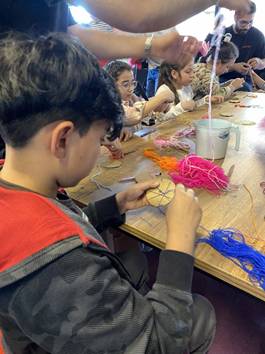
Throughout the workshop, children wrapped colorful wool pieces around cardboard to produce different designs. What initially appeared to be ordinary wool and cardboard pieces transformed into vibrant decorative products in the hands of the children. Some combined different colors to create patterns, while others experimented with textures to develop their own unique designs. In this way, children not only improved their manual skills but also experienced firsthand how unused materials could be repurposed.
During the workshop, the concept of sustainability was conveyed not only through theoretical explanations but also through direct production experiences. The environmental impact of the textile industry, waste generated during production, and the damage caused by unconscious consumption were explained through simple examples. In particular, discussions focused on how the concepts of “reuse” and “recycling” could be applied in daily life. Children discovered that even small materials could be transformed into new products when used thoughtfully.
One of the most valuable aspects of the workshop was the active involvement of the children in the production process. As they wrapped wool around cardboard, their attention, patience, and planning skills developed. Through color choices and design decisions, they were also able to express their creativity freely. By observing one another’s work throughout the process, children experienced the importance of collaboration and shared production.
At a time when many children spend most of their time consuming fast-paced digital content, this workshop offered them a different space where they could slow down. Touching materials, combining colors harmoniously, and creating a new product helped children move away from screens and focus on production. Realizing that every design requires effort, attention, and time became one of the most important lessons they gained during the process.
The colorful works produced at the end of the workshop demonstrated that sustainability is not only about protecting the environment. It is also an approach that involves rethinking production habits, using existing resources consciously, and developing creative solutions — all of which became visible through the children’s designs.
This workshop organized within the scope of SETAP became a memorable experience where children both developed environmental awareness and freely expressed their imagination in an enjoyable and educational atmosphere.