
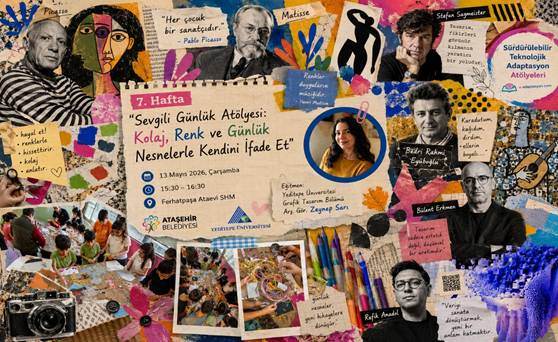
For a child, design is often much more than simply creating a beautiful picture. Design is one of the most natural ways of learning how to think, observe, make connections, and express oneself. Especially at an early age, experiments with colors, collage work, and productions based on transforming everyday objects allow children to interpret the world not only as they see it, but also as they imagine it. A button can become a planet, an old newspaper clipping can turn into a forest, and an unused box can transform into the hero of an entirely different story. It is precisely in this moment of transformation that creativity begins.
Today, the digital content children encounter mostly offers fast-consumed and one-directional experiences. Design-oriented creative processes, however, move children from being passive viewers to active creators. When a child chooses colors, cuts and shapes surfaces, or combines different materials to create new meanings, they simultaneously develop problem-solving, decision-making, and original thinking skills. Collage work, in particular, teaches children that experimentation and discovery are more valuable than perfection. The essence of collage lies in rethinking, rearranging pieces in unexpected ways, and stepping outside conventional boundaries.
Experts emphasize that art and design activities practiced at an early age support children’s cognitive development. Working with colors increases emotional awareness, while cutting, shaping, and arranging materials improve fine motor skills. Most importantly, children learn to express themselves through the works they create. Every child perceives the world differently, and design activities make these differences visible. For this reason, design education is important not only for raising future artists, but also for nurturing confident individuals who can think creatively and express themselves effectively.
The history of art and design offers many powerful examples of this. Many world-renowned artists and designers showed an interest in transforming the objects around them from childhood onward. For example, Pablo Picasso expressed his admiration for children’s creativity with his famous quote, “Every child is an artist,” and grew up immersed in drawing from an early age. Henri Matisse explored the emotional impact of colors and opened a new chapter in art history through his cut-out collage techniques. Similarly, Stefan Sagmeister, one of the most influential figures in contemporary graphic design and visual culture, often speaks about how the visual curiosity he developed as a child shaped his creative life.
Türkiye also has artists and designers who became interested in visual expression at a very young age. Bedri Rahmi Eyüboğlu created works inspired by the everyday life and ordinary objects of Anatolia, reinterpreting colors and patterns with a childlike sense of curiosity. Bülent Erkmen became one of the key figures demonstrating that graphic design is not only an aesthetic practice but also an intellectual form of production. Meanwhile, Refik Anadol, one of today’s most influential digital artists, has gained international recognition for redefining the boundaries of design by combining data, artificial intelligence, and architecture. All these examples show how visual discoveries made during childhood can evolve into powerful forms of expression later in life.
At this point, the SETAP Workshops go far beyond being merely children’s activities. Organized through the collaboration between Yeditepe University and Ataşehir Municipality, these workshops create a more conscious and production-oriented relationship between children and technology. In today’s world, it is impossible to remain completely distant from technology, yet using technology solely for consumption can limit children’s creative processes. The SETAP Workshops allow children to experience that it is possible to create, think, and share beyond screens. Through activities centered on art, design, and creativity, children not only engage socially but also gain the opportunity to transform their imagination into tangible creations.
Yeditepe University’s active role in this project also reflects an important perspective. Universities are not merely institutions that produce academic knowledge; they are also social structures that contribute to societal development. Projects supporting children’s creative growth are among the strongest examples of universities sharing their knowledge and experience with society. The workshops organized within SETAP establish a direct connection between the university and the community while helping children encounter art, design, and creative thinking at an early age.
At the same time, this process creates an important field of experience for students in Yeditepe University’s E-Commerce Department. Today, e-commerce is not only about making sales. It requires multidimensional skills such as user experience, creative content production, digital communication, brand storytelling, and developing socially beneficial projects. Students participating in the SETAP Workshops learn how to communicate with children, organize social responsibility projects, plan creative activities, and observe real societal needs beyond the digital world. This experience provides valuable social awareness for students who will one day work in brand management, digital marketing, and user-centered project development.
This week’s event, titled “Dear Diary Workshop: Self-Expression Through Collage, Color, and Everyday Objects,” placed exactly this creative perspective at its center. Conducted by Research Assistant Zeynep Sarı from Yeditepe University’s Department of Graphic Design, the workshop took place on Wednesday, May 13, 2026, at Ferhatpaşa Ataevi SHM. During the workshop, children explored what collage art is, experienced the emotional effects of colors, and reinterpreted everyday objects to create their own visual narratives. Together with their “big brothers and sisters” from the E-Commerce Department, each child joyfully designed their own visual diary.
Who knows—perhaps a small collage created by a child today will become the very first step of a great creative journey in the future. Because creativity often begins exactly like this: with a child being able to look at an ordinary object through different eyes.